In January, we had a friend visiting from the UK. We’ve been to Rio Lagartos before, so we thought it would be the ideal place to relax and show our friend the ‘real’ Mexico.
We had just spent a few days in Puerto Morelos on the Riviera Maya, with its beaches and tourist bustle. This was to be the antidote – and it was! We looked forward to a boat ride on the Ria, crocodiles, flamingos, and the Pink Lakes at Las Coloradas.
Our trip lived up to our expectations. Whether you’re coming from Cancun or Merida, the scenery and atmosphere change as you approach Tizimin, the last large town before the 45-minute drive to Rio Lagartos. Cattle ranches dominate, and the Yucatan forests are replaced by salt-stunted scrub. The villages get smaller, and the traffic disappears. You quickly realise you are on a path less travelled.
While many come to the Ría Lagartos Biosphere Reserve specifically to find the best time to see flamingos in Rio Lagartos, there are many other things to do in Rio Lagartos that make it a true escape from the crowds. Let’s explore them so you get to enjoy the best time!
First, let’s clear up the geography. Despite the name, this isn’t a river. It’s a Ría—a coastal inlet or estuary where the saltwater of the Gulf of Mexico pushes into the freshwater springs of the Yucatan’s underground aquifer.
The problem started when Spanish explorers in the 16th Century thought they were looking at a river – and one filled with alligators. So they called the area Rio Lagartos – Alligator River.
Regardless of their mistake, this saltwater estuary is a nutrient-rich mixing bowl. And it is exactly why the Ría Lagartos Biosphere Reserve is one of the most biologically significant places on the peninsula.
Part of its quaint charm is that Rio Lagartos is a real functioning fishing village. And that means there isn’t a lot to see in town. To get the best out of a visit to whole Ría Lagartos Biosphere Reserve and not just the town, you have to get on the water. Walk down to the malecón, and you’ll be greeted by captains in straw hats offering tours. In 2026, prices are relatively standardized, but it’s always worth a polite negotiation.
We used Felipe (Contact: 986 1078 158 ). By coincidence, this was the same boat captain we used a few years ago. And he is every bit as good now as he was then! He understands some English but only speaks Spanish. He is also the cheapest we found in January 2026, but without sacrificing any part of the tour.
The tours can be two or three hours. We opted for a two-hour tour, and that suited us perfectly.
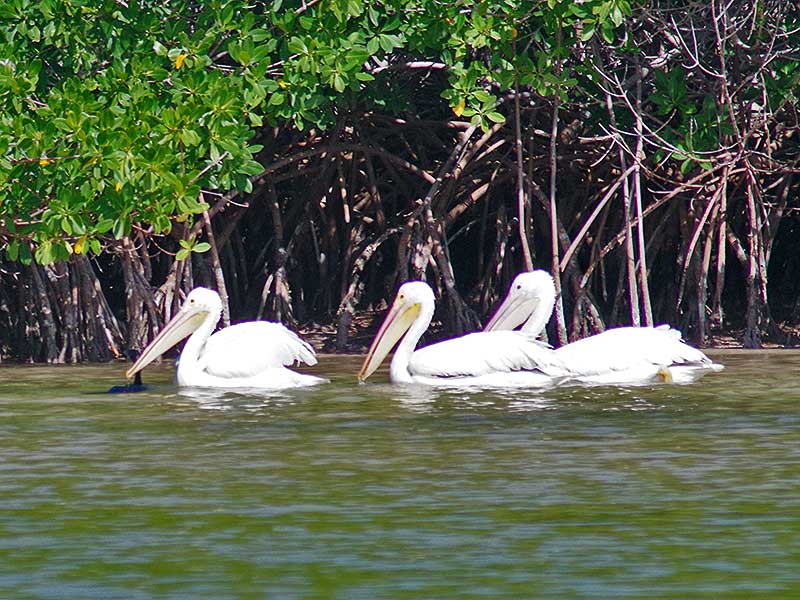
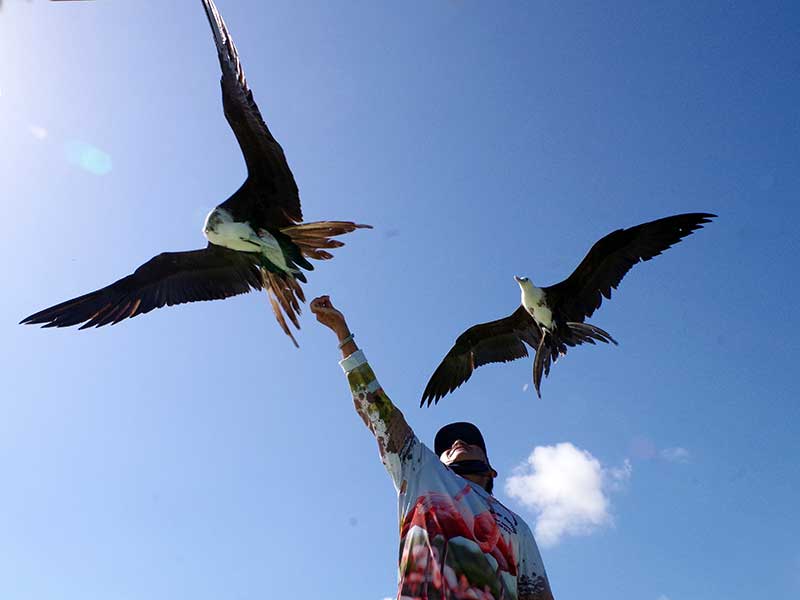
The tour will (should) include a stop at Las Coloradas, stopping en route to see flamingos, herons, and many other awesome birdlife in the Ria. You’ll see the three different mangrove species – red, white, and black. Felipe was able to get gulls to take bits of taco from his hands while they were in flight and pelicans to slide right up to the boat’s side.
Felipe also did the same with some Morelet’s crocodiles. We saw four crocs on this trip, ranging in size from 1.5 to 2.5 metres. In each case, they came right alongside the boat, providing awesome photo opportunities – and a few nervous giggles from one of our party!
None of the boat operators is allowed to feed the crocodiles these days to avoid disturbing their natural feeding patterns. The crocodiles don’t seem aware of this restriction and come alongside expecting a titbit. Presumably, fingers dangled in the water are welcome.
After the crocs, you’ll probably jump off the boat at Las Coloradas and see the pink lakes. It’s worth the jump – but don’t expect the chewing gun pink you’ve seen on Instagram (See why below). While you’re there, your guide will dig up a handful of thick, white sulfurous clay for later use.
After the ‘pink’ lakes, it’s an exhilarating boat ride back past Rio Lagartos to the mouth of the estuary, where you’ll put into shore again. Here you’ll slather on some of the thick, smelly mud the guide collected earlier. Once covered, you let it bake into a ghostly white mask in the sun. Then you’re meant to swim in the sea to wash it off. With luck, you’ll be able to admire your newly rejuvenated skin.
All in all, a great way to spend two or three hours.
While the flamingos are the undisputed rock stars of the Ría, treating Rio Lagartos as just a “flamingo spot” is missing the broader beauty of the biosphere. This is a world-class birding destination with over 390 recorded species.
Without doubt, flamingos are spectacular. Whether they’re head down in the water, shuffling their feet as they move forward to stir up food, or flying above like pink broomsticks with wings, they are a lovely sight. In our opinion, the ones we saw in January were pinker than those we’ve seen in Celestun or Progreso.
In January, several groups of flamingos are present, though it’s not peak season. The collective term for a group is ‘flamboyance’. From July to September, tens of thousands arrive from other parts of the Yucatan, creating a truly vibrant spectacle.
Due to changes in weather, human interference, and sea levels, the flamingo season can vary. So when is the best time to see flamingos in Rio Lagartos?
If you want to see thousands of flamingos, check before you make your trip—July to September is generally best, but timing may shift. Drop me an email, and I’ll give you an update on the best spot in the Yucatan for your dates.
For more photos of birds from Rio Lagartos and elsewhere in the Yucatan visit Wonky Compass: Birds of the Yucatan
For those carrying a long lens or a pair of 10x42s, keep your eyes peeled for the regional endemics. Look for the Yucatan Wren, which favors the scrubby vegetation near the town’s edge. In the mangroves, you’ll find the Boat-billed Heron with its oversized, scoop-like beak and large night-vision eyes.
If you’re lucky, you’ll spot the Bare-throated Tiger Heron or the Common Black Hawk, often seen perched on mangrove branches waiting for a crab to make a mistake.
The beauty of birding here is the lack of crowds. Even out of season, there are boats going back and forth – some with tourists and others fishing. But if you let your guide know what you want to do, you can sit in the boat as long as you want, watching or photographing the myriad birdlife.
About 30 minutes east of Rio Lagartos lies Las Coloradas. You can’t miss the signposts.
The road is in fairly good condition, with ample space for passing any lorries that get in the way. As you get closer, the landscape changes. The sea appears, and when you are only a few kilometres away from the lakes, you will see the huge, snowy mountains of salt appear on the horizon.
Where to Park: The first sign you will see is for the “Las Coloradas Visitor Center.” You can follow that sign, but you will be hassled endlessly by tour ‘guides’ on mopeds.
I would suggest you drive past the first entrance, ignoring the tour touts, and take the first turning on your right. That will take you to another entrance to the visitor center car park.
It’s worth parking in the official visitor center car park. It’s safe, and it puts you right at the entrance for the walking or bicycle tours.
Is it worth it? This is a tricky question. These tours have become expensive tourist rip-offs. As of 2026, the salt factory has gated the most vibrant ponds to ‘protect the salt quality’.
The reality is that it’s to gather as much cash from tourists as possible. Whether you want to be gouged by the salt company or not is up to you. You’ve probably come a long way and sacrificed a day of your vacation to be here, so…why not?
A possible alternative: If you’re on a budget, keep driving past the town toward Playa Cancunito. There are stretches of road where the fence drops, and you can see the unmanaged ponds for free. They aren’t as vivid, but they are still beautiful.
To see the pink at its most intense, you need the sun directly overhead.
The pink color is a reflection. At 9:00 AM or 5:00 PM, the light hits the water at an angle, making it look brownish or dull. Between 11:30 AM and 1:30 PM, the sun penetrates the shallow brine and reflects off the white salt floor, turning the lagoons into a brilliant bubble-gum pink.
Now that’s the theory. According to our guide, if there’s been work on the lake, it will take a few hours to settle down. In January 2026, we went to the lakes on two separate days at 1:30 and at 3:00 (and via our boat trip at 10:30), and none of the lakes were pink, as shown in the photos above.
On our previous trip, some lakes had a stunning vivid pink hue, as shown in the photos below.
You may be more fortunate than we were this time. I hope you are. It’s worth the trip to the lakes, even if they’re not bright pink. So, in many ways, you’ve got nothing to lose!
What a difference a bit of sun makes!
There are dozens of beautifully painted houses on the main road and down back streets. Some are a single color, others have intricate murals painted on.
We spent more time than we intended wandering the streets enjoying the vibrant colors!
Unlike the Riviera Maya, which seems to exist solely on tourism, Rio Lagartos exists because of its fishing. The town lives and dies by the “Seasons of the Sea.” Tourism is simply a nice sideline (and hopefully, that will be the case for many years to come).
Other sources of income are:
Salt: Salt has been harvested here since the Maya used it as a currency. Today, the industrial salt works at Las Coloradas are one of the largest in Mexico.
Octopus (Pulpo): If you visit during the fall/winter, you’ll see the alijos (small boats) piled high with long bamboo poles used to catch octopus.
Handicrafts: Look for local woodcarvers. Unlike the mass-produced masks in Chichén Itzá, artisans here carve incredibly lifelike birds from local cedar and zapote wood. They are heavy, fragrant, and a true piece of the Ría to take home.
In 2026, the hotel scene is still small, which is a blessing. However, don’t expect 5-star resort-class hotels. When you book your hotel, check its location. There is only one hotel that is actually on the seafront – the others face the sea but have a road between them and the water.
Like in any small Mexican town, mopeds travel the roads at night. Nevertheless, there are not enough people in Rio Lagartos to generate significant traffic noise.
Here are my top three picks for a one or two-night stay:
Currently the tallest building in town, its rooftop provides sweeping 360-degree views of the estuary. At night, guests can enjoy drinks and take advantage of minimal light pollution for stargazing (you may need to bring your own binoculars).
This is the only truly waterfront hotel, and a great feature is the little platform over the estuary with seats and tables. It’s ideal for watching the sunset and the fishing boats going out.
A word of caution: some of the ocean view rooms are also right on the road, so expect some traffic noise.
This is our go-to hotel in Rio Lagartos. There may be better, but we like it!
In Rio Lagartos, be warned: don’t leave it too late to find somewhere to eat. This is a town that follows the sun. By 9:00 PM, most kitchens are being scrubbed down, and by 10:00 PM, the only thing moving is the occasional crocodile in the canal.
If you wait until 8:30 PM to start looking for a table, you’re going to end up with a snack from the OXXO.
https://www.facebook.com/Dejavubarsnack/
https://www.facebook.com/maleconcitogourmet/
https://www.facebook.com/p/El-Perico-Marinero-R%C3%ADo-lagartos-Yucat%C3%A1n-100063479171812/
The Yucatan is incredibly easy to navigate by car. So far as we’re concerned, it’s very safe. The driving is typical Mexican – lots of long straight roads in excellent condition. And then some that are not!
Whichever route you take, you’ll end up near Tizimin. Look out for Café Estación 1888. It’s a lovely coffee shop and a nice break before the Tizimin/Rio Lagartos leg of the journey.
From Merida, you’ll need to detour about 15 minutes toward Valladolid. We think it’s worth the diversion for the leg stretch!
If you’re coming from Cancun, there’s no detour. The coffee shop is about 10 minutes before Tizimin, on the left-hand side.
From Tizimin to Rio Lagartos, you’ll notice a change in the roads. They’re narrower and less well-maintained. They’re not bad, but expect some potholes.
There is now a Pemex station in Rio Lagartos, but it’s worth filling up before you get there, just to be safe.
We always enjoy our trips to Rio Lagartos and San Felipe. This is not a trip for someone looking for souvenir shops, nightlife, and top-end restaurants. This is a great day trip – or better as a two-day trip – to relax, see some wildlife, have a boat trip, and enjoy good seafood. Oh, and did I say relax!
It remains one of the few places in the Yucatan that feels untouched by tourism and still truly wild.
No. As of 2026, the Ría Lagartos Biosphere Reserve has a strict “No Drone” policy to avoid stressing the flamingo colonies (those birds are jittery). At the Las Coloradas salt flats, drones are also forbidden because it’s private industrial property. If you try it, expect a very fast visit from security or a federal ranger.
Yes, and it’s not always reliable. It’s located in the Municipal Palace. In 2026, many of the boutique hotels and the salt park entrance now take cards, but cash is still king for boat captains and local taco stands. If that one ATM is out of service, your nearest backup is a 50km drive back to Tizimín. Don’t risk it; bring pesos from Merida or Cancun.
The “crocs” here are Morelet’s crocodiles. While they are definitely apex predators, they generally stick to the deeper mangrove shadows. The white mud bath areas are in shallow, open flats where you can see anything coming from a mile away. Your guide does this three times a day—they aren’t looking to lose a tourist. Just don’t go wandering into the mangroves alone at dusk.
With a good boat captain or guide you can get very close to the crocodiles during the boat trip – too close for one of the Wonky Compass team! But it’s quite safe.
If you want a specific “name” guide (like the legendary Diego Nuñez) or a specialized sunrise birding trip, yes—book ahead.
If you just want a standard 2.5-hour tour of the flamingos and mud bath, you can literally walk down to the malecón at 9:00 AM and have three captains offering you a boat within thirty seconds.
With our boat, Felipe wanted MXN200 the night before to book his boat. In our opinion, it was money well spent and was deducted from the final price.
The official answer is: Absolutely not. This is the #1 question people ask, and the answer remains a firm no.
The lakes are private salt-production ponds. The water is extremely salty and can be highly acidic during certain stages of evaporation—it would sting like crazy, ruin your swimsuit, and likely get you arrested.
Having said that, we saw two young ladies clamber into one of the Pink Lakes for photos and selfies.
It much more sensible to stick to the beach at Playa Cancunito if you need a dip.
Because you are entering a UNESCO Biosphere Reserve, you are legally required to wear a federal conservation wristband (Brazalete de Conservación). In 2026, these cost about 140 MXN (approx. $8 USD).
Usually, your boat captain will collect this fee from you and provide the band, but make sure you’re wearing it; federal rangers do occasionally patrol the water.
That said, we’ve never been asked for one or seen any sign of any rangers who would ask for one.
We were told that in 2016, the rangers were being more thorough with colloecting the fee. It’s likely this will only be at busy periods like Easter and the peak flamingo season.
Check with your boat captain – they will often know the latest information.
Copyright 2026 www.wonkycompass.com