Coba Ruins 2026: Climbing Nohoch Mul is Back!

Climbing Coba Mayan Ruins in 2026-Header

Table of Contents - Quick Links

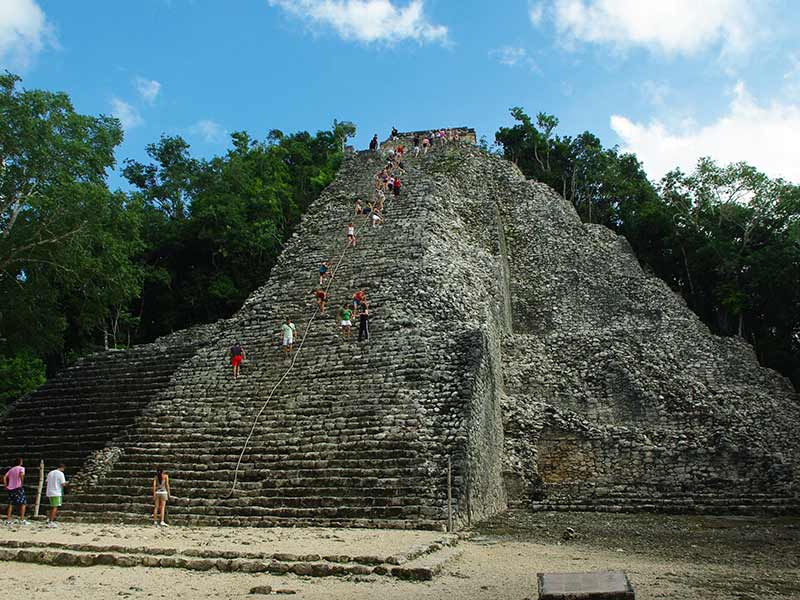
Climbing Coba Mayan Ruins in 2010 using the rope
Climbing Coba Mayan Ruins in 2010 using the rope. And far fewer people.
Climbing Nohoch Mul at Coba in 2026 using the steps with much larger crowds
Climbing Nohoch Mul at Coba in 2026 - using the wooden steps.

What is it like Climbing Nohoch Mul in 2026?

Coming back to the Coba Ruins felt like a full-circle moment for Wonky Compass. My first introduction to this site, back in 2010, was a day trip from Akumal. Back then, we were based on the coast, and the drive was a quick 70 kilometers (45 miles) inland that took about an hour.

It was the standard ‘vacation day trip’ route, much like the one thousands of people take daily from Playa del Carmen, 110 kilometers (68 miles) away, with an average 90-minute drive depending on Tulum traffic.

A visit in January 2026 was different. We were on a drive from Mérida to Playa del Carmen, to drop a friend of at the Cancun airport. It’s an easy two-and-half-hour drive of about 220 kilometers (135 miles) on good roads. Once you turn off the Merida-Cancun Highway near Valladolid, you are driving through jungle and small villages, with little or no traffic. And still on good roads.

In 2010, the maps were more basic and needed replacement due to the environment
In 2010, the signage and maps at Coba were more basic
In 2026, the signs are more useful and helpful, with images and maps
In 2026, there is an obvious upgrade in quality, both in the presentation and information, plus English is shown aloing with Spanish and Mayan

The Natural Mirror: Lake Coba and the Crocodile Watch

As you drive toward the entrance of the Coba archaeological zone, you skirt the edges of Lake Coba. Unlike the cenotes you’ll find dotting the landscape elsewhere, this is a natural, permanent lagoon—one of five in the area.

In a region where water usually lies underground in limestone caverns, these lakes are why Coba exists. They allowed this city to thrive in an otherwise dry landscape, supporting a large population for centuries. Some estimates put the population at 50,000 or more people at its peak.

Coba wasn’t just a temple site, it was a lakeside metropolis. Estimates put the size of the inhabited area of this sprawling city at an amazing 80 square kilometers (about 30 square miles).

We didn’t stop to explore the lake on this trip due to time constraints, but the view of the lake through the trees is a stunning introduction to the site. These waters are home to Morelet’s crocodiles. Even if you don’t see them as you drive past (we didn’t), the locals will tell you the modern-day dinosaurs are lurking in the water, a silent part of the ecosystem that hasn’t changed since the first stones were laid here.

Morelets Crocodile head
Morelet's Crocodile thrive in the Coba lagoons
Morelets Crocodile sideview
We didn't see any Morelet's Crocodile on this trip. These two are from Rio Lagartos - but they are just as dangerous!

Navigating the Sprawl: The 2km Reality Check

Coba remains a sprawling site. Unlike the compact, geometric layout of Uxmal, Coba is a vast network of ancient sacbeob (white roads) hidden under a dense canopy.

Do not underestimate the distances. From the entrance gate to the base of the main pyramid, Nohoch Mul, it is a solid 2-kilometer (1.2-mile) trek. One way. In the heat. It is not a short walk!

Two members of the Wonky Compass team decided they wanted the “authentic” experience and started walking. They quickly realized this wasn’t the wisest idea, especially as time was against them. We arrived in the afternoon, unaware that the final climb of the day was at 3:30 pm.

We managed to grab a Mayan Limo to speed them on their way. Mayan Limo? Read on…

The younger members of the Wonky Compass team - Tabitha and Natasha - enjoying the ride
Tabitha and Natasha sharing a Mayan Limo to avoid missing the cut-off time
David and Lesley (and crutches) being driven by a friendly Mayan Limo driver
A friendly Mayan Limo driver makes the journey easier for Lesley and her crutches (and David)

Coba Bike Rentals and Mayan Limos: 2026 Prices

The “Mayan Limo” is a local pedicab where you sit in the front and a local guide pedals from behind. In 2010, the tricycle taxis felt like a quirky novelty. And we felt bad about putting the poor guys through the struggle of taking three adults on the front, despite their willingness to take us! Back then, there were far fewer visitors to Coba.

In 2026, the tricycles are a logistical necessity. My wife, Lesley, recently had an accident that has meant she is temporarily on crutches. It was an easy decision to jump on one.

We found the ‘cab drivers’ friendly and helpful. Our driver was kind enough to cycle back to where Lesley waited, saving her from having to walk on the rough pathway. (It’s not rough unless you’re on crutches!)

On the way to the main pyramid, we passed our two companions who were struggling against time. Our driver quickly organised another Mayan Limo to pick them up, so we all made it in time for the last climb.

The Mayan Limos are very well organised. Unlike 2010, when there was bargaining over prices, today they are published on the wall of the ‘headquarters’ – a wooden shed in the jungle.

Prices for the Mayan Limos are clearly posted on the wooden hut
The Mayan Limo prices are clearly marked - and good value!
Mayan Limo riders getting their pedicabs ready under the trees.
Getting their Mayan Limos ready for the next rush of tourists

Mayan Limos – the best way to travel (at the ruins)

The “Mayan Limo” is a local pedicab where you sit in the front and a local guide pedals from behind. In 2010, the tricycle taxis felt like a quirky novelty. And we felt bad about putting the poor guys through the struggle of taking three adults on the front, despite their willingness to take us! Back then, there were far fewer visitors to Coba.

In 2026, the tricycles are a logistical necessity. My wife, Lesley, recently had an accident that has meant she is temporarily on crutches. It was an easy decision to jump on one.

We found the ‘cab drivers’ friendly and helpful. Our driver was kind enough to cycle back to where Lesley waited, saving her from walking the rough pathway. (It’s not rough unless you’re on crutches!)

On the way to the main pyramid, we passed our two companions who were struggling against time. Our driver quickly organised another Mayan Limo to pick them up, so we all made it in time for the last climb.

For our party, the “Mayan Limo” was the difference between reaching the pyramid in time for the climb and being left standing at the bottom looking at our watches.

The Mayan Limos are very well organised. Unlike 2010, when there was bargaining over prices, today they are published on the wall of the ‘headquarters’ – a wooden shed in the jungle.

What does a Mayan Limo cost in 2026?

  • Current Price (2026): We paid 180 MXN (roughly $12 USD) in 2026 for a round-trip that seats two. (We also gave a tip, but it wasn’t asked for)
  • Bike Rentals: If you prefer to pedal yourself, bikes are available for around 65-80 MXN.
  • Why it’s a good idea: It isn’t just about the legs or crutches. The drivers provide a breeze that you simply won’t get while walking in the 90% humidity. It turns a 25-minute sweaty trudge into a 10-minute shaded glide through the trees.

Climbing Nohoch Mul at Coba and 2026 Regulations

The biggest question for any visitor to the Coba ruins over the last few years has been: Can you still climb the Coba ruins? After years of closures due to conservation and safety concerns, the answer is finally yes, but with a modern, regulated twist.

The days of the free-for-all scramble are over. To preserve the original limestone blocks—which were being worn smooth by millions of rubber soles—authorities have installed newly constructed wooden stairs over the center of the pyramid.

  • The Group System: Access is strictly regulated. Only 14 people are allowed on the stairs at a time. This prevents the “bottleneck” anxiety of the past and ensures that if someone slips, they don’t take a dozen people with them.
  • The Physicality: Even with the stairs, don’t be fooled—it is still a vertical challenge. We watched several people struggle as they neared the top. The stairs are steep, and the humidity makes every breath harder than the last.

    Wanting good photos, I didn’t want to be stuck behind anyone struggling on the steps. So, as the first on the steps, I foolishly raced to the top – all 120 steps to climb 42 meters (138 feet) to the summit. I made it ok but my legs were absolutely jelly! I had to stay away from the edge for a few minutes until they stopped shaking! My advice – take it easy. The summit isn’t going anywhere!
  • The 3:30 pm Cutoff: This is the most important piece of advice I can give you. The last climb of the day is at 3:30 PM. If you aren’t at the base of Nohoch Mul by then, the guards will politely but firmly turn you away. (Check at the gate for seasonal variations as INAH does occasionally extend the time at busy times.)
Climbing Nohoch Mul at Coba in 2010 was a risky business. It looks a long way down!
Back in 2010, climbing Nohoch Mul was a risky business. It took nerves of steel!
Climbing Coba Nohoch Mul using the new wooden steps in 2026 is so much safer!
Climbing Nohoch Mul using the new wooden steps in 2026 is much safer!

Why Climb Nohoch Mul?

Nohoch Mul is the tallest Pyramid in the Yucatan Peninsula. And the reward for climbing to the top remains unchanged from my 2010 visit. Standing above the tree line, looking out over an unbroken ocean of green, is an incredible sight. You are confronted with a vast panorama, which makes you feel very small!

Don’t under estimate the steepness of the climb. But the rewards for standing in the queue and reaching the top are well worth it!

David from Wonky Compass stands on top of Nohoch Mul in 2026
David stands on top of Nohoch Mul in 2026. Even after 15 years, the vast panorama of jungle remains
In 2010, Tabitha sitting on top of Nohoch Mul with the jungle behind her
In 2010, Tabitha sits on top of Nohoch Mul. Behind her is a sea of green jungle

Navigating the Coba Ruins: Don’t miss these hidden gems

Because the Coba site covers nearly 30 square miles, what you see as a visitor is actually a series of “island” clusters connected by the forest floor. If you only visit the main pyramid, you’re missing the city’s social and spiritual heart.

The Coba Group & La Iglesia

This is the first cluster you’ll hit after the entrance. It houses La Iglesia (The Church), which, at 24 meters (79 feet), is the second-tallest structure on the site. Even in 2010, you couldn’t climb this one.

In front of the building, under the thatched palapa, you can see Stella 11. This is thought to depict a ruler and is considered sacred, with locals sometimes referring to it as the Virgin “Colebí”.

Recently, the lower portion of Stella 11 was found behind the upper portion, and was inscribed with the name of a previously unknown ruler – Xaman K’awiil.

La Iglesia - the Church - at Coba Yucatan among the forest trees.
La Iglesia (the Church) at Coba. You are not allowed to climb these steps.
La Iglesia - the Church - at Coba showing Stella 11 under the palapa
La Iglesia (the Church) showing Stella 11 under the thatched palapa

The Ball Courts

Coba actually has two separate ball courts. The one in the Coba Group is smaller, while the court near the Nohoch Mul group is larger and features more intricate stone rings. Look for the carvings of skulls and the “Venus” symbols on the rings—chilling reminders that these “games” often had high-stakes ritual endings.

These Ball Courts differ from the ones at Chichén Itzá as they have sloping walls.

Coba Group Ball court showing both walls
Coba Group Ball court showing both sloping walls, with the rings in the center of each wall.
David from Wonky Compass standing by the sloping walls of the Coba Group Ball Courts
Me standing by the sloping walls of the Coba Group Ball Courts. One of the Rings is visible on the wall above me.

Xaibé ‘Observatory’

Located at a crossroads of four different sacbeob, this semi-circular structure is unique in Maya architecture. Its name means “crossroads,” and its 20 steps are widely believed to represent the days of the Maya month.

This is in part due to it’s rounded shape, which is unusual in Mayan architecture. Although termed ‘the Observatory’ in English, its true function is still unknown.

Xaibe building at Coba in 2010 with Lesley and Tabitha
In 2010, Lesley and Tabitha at the side of the Xaibe building
Xaibe building at Coba, Yucatan in 2026
Xaibe building in 2026, with a palapa protecting the remains of a stela

Stela 20

This stela is the depiction of Chan Kinich, the last Mayan king known to archeologists.

Although hard to make out, even with the lines of the sign overlaid on the actual stone, the king is allegedly is standing on the backs of two captives with ropes around their wrists. Stela 20 is located in the Nohoch Mul Group in the X structure. It is said be date to November  780 CE (or AD).

There are plenty of stelae hidden around the Coba ruins, between 20 and 30. The largest group comprises of eight at Macanxoc Group, along with various altars.

An 11 metre (30 feet) stela was discovered in 2024, naming a new, previously unknown rules – K’awiil Ch’ak Chéen.

Stela 20 at Coba Ruins
Stela 20 sign and image
This is the sign and a close up of the image for Stela 20
Ancient Mayan Stela 20 stone carving at Coba ruins with line drawing overlay
Using a line drawing overlay to reveal the intricate details of Stela 20.

The Macanxoc Group

This is the quietest part of the site. It’s a 10-minute bike ride away from the main path. As mentioned above, it contains the highest concentration of stelae—massive stone slabs used by the Maya as a public record. Stela 1 is the most famous, as its inscriptions famously referenced the end of a “Great Cycle” in the Maya calendar in December 2012.

Sacbe 1

One of the most impressive features of Coba is Sacbe 1, the longest ancient “white road” ever discovered in the Maya world. Stretching roughly 100 km (62 miles), this raised limestone causeway runs almost perfectly straight from the heart of Coba all the way to the city of Yaxuná, near Chichén Itzá. The road was roughly 10 meters (33 feet) wide and paved with bright white plaster. An amazing feat for the period.

The road begins near the Nohoch Mul Group, just west of the Ixmoja pyramid, at a junction where several roads meet. Unsurprisingly, you can’t walk the full 100 km to Chichén Itzá today as the jungle has reclaimed much of the path beyond the archaeological zone. But you can walk or bike the first few hundred meters/yards.

Coba Ruins Entry Fee 2026

As of January 2026, the federal INAH fee for “Category I” sites like Coba is 210 pesos for foreign tourists. Mexican citizens or foreign residents with a valid residency card (Residente Temporal or Permanente) pay a discounted fee of 105 pesos. For these residents and citizens, entry is free on Sundays, though you may encounter larger crowds.

In addition to the INAH ticket, there is a local community (ejido) fee of 120 pesos that applies to everyone regardless of residency. This money goes directly to the local Maya community that manages the land and the bike rentals.

There is also a 100 peso parking fee, payable as you enter the main gate.

You can check the INAH site for the latest entry prices to Coba here: INAH Zona Arqueologica de Coba

Entrance fee at Coba Ruins, Yucatan
2026 INAH Entrance fee at Coba Ruins, Yucatan
Entrance times at Coba 2026
Entrance times and costs at Coba 2026, with notice saying they accept cards

Food, Drinks, and Trinkets in the car park

The area around the car park and entrance is a bustling area of local commerce. You’ll find a handful of small, open-air restaurants (like Chile Picante or El Cocodrilo) serving standard Yucatecan fare—typical handmade tortillas and fresh fruit juices—which are perfect for a post-walk meal.

For a quick grab-and-go, there are convenience stalls stocked with cold Gatorade, water, and snacks.

The souvenir shops here are less aggressive than those at Chichén Itzá, mostly selling the local “Coba” staples: hammocks, carved wooden masks, and embroidered linens.

Read here what it’s really like at Chichen Itza

Oddly, the whole area looked remarkably similar to what it did in 2010!

The best ways to reach Coba

Getting to Coba depends largely on your starting point, as the site sits at a strategic crossroads between the coast and the interior. Here is how to navigate the trip in 2026:

  • From Tulum: Roughly 47 km (29 miles) away, Tulum is the most practical jumping-off point. A car or taxi ride takes about 45 minutes. Buses (ADO/Oriente) and colectivos have frequent departures that drop you a short walk from the lagoon-side entrance.
  • From Playa del Carmen: Expect a journey of about 110 km (68 miles). Driving is the most efficient choice, taking roughly 90 minutes. While buses are available, they often require a transfer in Tulum, making the total travel time close to 3 hours, which is less practical for a day trip. Taxis are available but they are significantly more expensive due to the distance.
  • From Mérida: The drive is approximately 220 km (135 miles) and takes about 2.5 to 3 hours on well-maintained highways via Valladolid. Because there is no direct bus from Mérida to Coba, you would typically need to take a bus to Valladolid or Tulum first and then transfer. For this route, a rental car is the only truly practical way to visit and return in one day.

Using the Tren Maya for Coba Ruins

In 2026, the Tren Maya may look like a modern alternative, but the ‘last mile’ is a significant hurdle. Most stations were built far from the actual ruins to protect archaeological heartlands and the delicate jungle floor.

For Coba, the closest stops are Tulum (45 kilometres / 28 miles) and Nuevo Xcán (47 kilometers / 29 miles). Neither is a “hop off and walk” situation; both require a substantial (and often expensive) taxi or shuttle ride to reach the site entrance. Given that 2026 reports still mention limited daily frequencies and occasional delays, a rental car or the reliable ADO bus remains the safer, more cost-effective bet for a day trip.

(Note that the Tulum Tren Maya station is close to the Tulum Airport and about 5km or 3 miles from the town center.)

Expert Tips for your 2026 Visit

  • The 3:30 pm Cutoff: This cannot be stressed enough. If you want to climb, you must be at the base of the pyramid before the cut-off time. Aim to enter the park by 1:30 PM at the latest. (Check at the gate for seasonal variations, as it may be extended in busy seasons.)
  • Climbing Nohoch Mul, the Pyramid: This is one of the highlights of the trip. Be aware of your limitations. Don’t try to rush to the top. If you have doubts about your ability to make it to the top, aim to be at the rear of the group to avoid being rushed, and take your time.
  • Cash is Essential: While the main gate may accept cards (if their machine is working), the “Mayan Limo” drivers, bike rentals, and local snack vendors are cash-only. Bring enough pesos for the whole day.
  • Footwear: Even with the wooden stairs, do not wear flip-flops. The ground leading up to the pyramid is uneven limestone and tree roots.
  • Heat: Summer in the Yucatan can be hot. Very hot. Bring a hat, sunscreen, and water.

The History of Coba: From 1882 Discovery to 2026 Excavations

Unlike other Mayan sites that were documented early in the colonial era, Coba’s location and the regional instability of the 19th century kept it a “lost city” for much longer.

John Lloyd Stephens was the first to mention Coba in print in 1842, though he never reached it. It wasn’t until 1882 that Juan Peón Contreras produced the first sketches. However, the first photographs were taken by Teobert Maler in 1891.

He made an arduous two-day trek to the site, capturing the first grainy images of a city that had been swallowed by green for nearly a thousand years.

The 1920s Carnegie Expeditions

The real “unveiling” of Coba happened in February 1926, almost exactly 100 years before our visit yesterday. The Carnegie Institution of Washington (CIW) launched a series of expeditions led by legendary archaeologists like Sylvanus Morley and J. Eric S. Thompson. These teams were the ones who mapped the sacbeob (white roads) and discovered the Macanxoc stelae.

It was during these trips that the sheer scale of Coba—a city that once controlled the trade routes between the coast and the interior—began to be understood. They found that Coba wasn’t just a site; it was the hub of a massive “highway” system, with one road stretching over 100 kilometers to Yaxuná, near Chichén Itzá.

The 1970s and the INAH

It was only in 1973 that the site officially opened to the public as a tourist attraction. This followed a massive consolidation project by the INAH (National Institute of Anthropology and History) that began in 1972.

The 1970s saw the first real modernization—rough paths were cleared into wide trails, and basic signage was installed. This coincided with the development of Cancun, as the government looked for “inland” attractions. The 1990s brought the formal bike rental systems we use today.

Recent Discoveries (2024–2026)

Thanks in part to the excavations surrounding the Mayan Train project, more discoveries have been made. During excavations in 2024 and 2025 to prepare the nearby rail corridors, archaeologists unearthed a massive 11-meter-long stone stela near the Nohoch Mul group.

This stela features 123 hieroglyphics that describe the city’s founding in A.D. 569. Most excitingly, it named a previously unknown ruler, K’awiil Ch’ak Chéen.

Black and White photo by Teobert Maler taken in 1891
The first recorded image of Coba by Teobert Maler in 1891. Courtesy INAH Archives
Sign showing history of the Coba Ruins
In 2026, there are excellent sign showing the history of the Coba Ruins, mentioning people like Theobert Maler

Beyond the Ruins: Cenotes and Day Trips

No visit to Coba is complete without a cooling plunge into the local underground cenotes. Located just a few minutes’ drive (or a short bike ride) from the archaeological entrance, you’ll find a cluster of three distinct caverns: Choo-Ha, Tankach-Ha, and Multum-Ha.

Choo-Ha is perfect for families with its shallow, crystal-clear pools and dripping stalactites, while Tankach-Ha offers two high-diving platforms for those seeking a shot of adrenaline.

For a more tranquil experience, head further down the road to Multum-Ha, a deep, perfectly circular cavern that feels like swimming in a massive cathedral. Entry fees for 2026 are approximately 100 pesos per cenote, and they offer a much more authentic, low-crowd experience compared to those closer to the coast.

If you aren’t staying in the village of Coba itself, the ruins make for a fantastic and easy day trip from Valladolid. The drive is a straight, 60-kilometer (37-mile) run through the jungle that takes about 45–50 minutes, allowing you to beat the Tulum tour buses if you start early.

Read More: Everything you need to know about visiting Valladolid.

FAQs about Visiting Coba Mayan ruins

Is it possible to climb the main pyramid at Coba?

Yes, as of January 2026 the Nohoch Mul pyramid at Coba reopened for climbing but it is now regulated. You must use the newly installed wooden stairs, and only 14 people are allowed on the ascent at any one time. The last climb starts at 3:30 pm (Check at the gate for seasonal variations). The climb is 42 meters (138 feet) and, once at the top, you have stunning views across the jungle canopy.

Are the Coba ruins worth visiting?

Absolutely. Not just for climbing Nohoch Mul – Coba is a unique archaeological site. It’s less crowded than Chichén Itzá and makes an excellent day trip from the Riviera Maya.

How much time do you need at Coba ruins

Because the site is so spread out, you should allow at least 2.5 to 3 hours. If you walk the 2km to the main pyramid instead of renting a bike or “Mayan Limo,” add an extra 45 minutes to your total time.

What’s the best way to visit Coba from Tulum?

ADO buses run regularly from Tulum to Coba from Tulum – check the return times. The bus journey is about an hour.

Taxis will do the return journey from Tulum. Alternatively, to give yourself more freedom to visit the cenotes, consider hiring a car. It’s about 40 minutes by car or taxi.

Read here to learn about great cenotes to visit in the Tulum region.

Most hotels offer tours to Coba, often with other stops along the way.

What’s the best way to visit Coba from Playa del Carmen?

A bus journey is possible, but at nearly 3 hours each way, it’s not really practical. A rental car or taxi both take about 1 hour and 30 minutes, so these are good options and let you stop at cenotes on the way there or on the return.

Alternatively, look for tours. These will remove the hassle and often offer other stops en route.

Is Coba wheelchair or stroller accessible?

The main paths (sacbes) are wide but very uneven with rocks and roots. While a “Mayan Limo” can transport someone with limited mobility to the pyramid base, the ruins and the pyramid stairs are not wheelchair accessible. My wife was using crutches after an accident and found walking along the paths a challenge- the “Mayan Limos” were ideal!

What should I bring when I visit Coba?

High-quality insect repellent (the jungle mosquitoes are intense), plenty of water, a sun hat, and Mexican Pesos for all onsite rentals and local vendors. Due to the fierce sun, wearing swimwear is inadvisable- if you plan to climb the pyramid, it’s best to wear clothes that cover but are light and comfortable shoes not flip flops.

Coba vs Chichen Itza?

A lot depends on where you are staying and what you want to see. The two archaeological sites are both important, impressive, and yet very different.

From Playa del Carmen, you may feel that Chichén Itzá is easier to get to. From Tulum, Coba is definitely the easier option. Chichén Itzá is unashamedly touristy and crowded. Yet it is impressive, and if you tell your friends, they will likely be jealous.

Coba is more of an adventure. You will walk further to see the different ruins and, sadly, your friends are likely to say “where?” when you tell them you visited Coba. But you can climb the Nohoch Mul pyramid and have fun!